
The following materials and findings are from The Jewish Majority’s 2026 survey of Jewish early voters in Michigan’s general election.
FOR IMMEDIATE RELEASE: November 3, 2026
Contact: jewishmajority@berlinrosen.com
EL-SAYED UNDERPERFORMS BENSON BY MORE THAN 20 POINTS AMONG MICHIGAN JEWISH EARLY VOTERS
99% of Jewish Democrats Who Rejected El-Sayed Say They Likely Would Have Voted for a Different Democratic Nominee; Antisemitism and Israel Among Top Reasons Cited
Michigan — A new exit poll of 482 Jewish early voters in Michigan, conducted October 25-31 on behalf of The Jewish Majority, finds that Democratic U.S. Senate nominee Dr. Abdul El-Sayed dramatically underperformed other Democrats among a heavily Democratic Jewish electorate. Just 57% of all Jewish early voters surveyed cast a ballot for El-Sayed, compared with more than 78% who supported Democratic gubernatorial nominee Jocelyn Benson on the same ballot, a gap of more than 21 percentage points.
The results point to a rejection of El-Sayed rather than a broader break with the Democratic Party: 75% of voters surveyed identify as Democrats or Democratic-leaning independents, and 99% of self-identified Democrats who did not vote for El-Sayed said they likely would have supported a different Democratic nominee. Those voters overwhelmingly cited concerns about antisemitism, El-Sayed’s positions on Israel and his treatment of Michigan’s Jewish community as reasons for withholding their support.
Data Snapshot
- 57% of all Jewish early voters surveyed backed El-Sayed, compared with more than 78% who backed Benson on the same ballot, a gap of more than 21 points.
- One-third of voters who recalled supporting Democratic Senator Elissa Slotkin in 2024 did not support El-Sayed in 2026.
- 99% of self-identified Jewish Democrats who did not vote for El-Sayed said they likely would have voted for a different Democratic nominee, including 88% who said they were “very likely” to do so.
- Among those same Democrats, 92% cited concerns about antisemitism and 92% cited El-Sayed’s positions on Israel as reasons they did not support him.
- 65% of Jewish voters who voted for Republican Mike Rogers said they would have considered voting for a different Democratic nominee.
Jewish Voters Rejected El-Sayed, Not the Democratic Party
Among Jewish early voters who supported Republican Mike Rogers, 61% described their vote as mainly against El-Sayed, compared with 17% who said it was primarily in support of Rogers. Among self-identified Jewish Democrats who voted for Rogers, that figure rose to 92%. Republican Mike Rogers received 34% of all Jewish early-voter ballots surveyed, compared with 19% for Republican gubernatorial nominee John James. Another 5% left the Senate race blank, compared with just 1% who left the governor’s race blank. Even among Rogers voters, 65% said they would have considered supporting a different Democratic nominee.
Antisemitism and Israel Drove Opposition to El-Sayed
Beyond the concerns about antisemitism and Israel cited in the poll’s topline findings, 87% of self-identified Democrats who did not support El-Sayed pointed to his comments following the attack at Temple Israel, 84% cited his treatment of Michigan’s Jewish community, and 74% cited the people he campaigned with or accepted support from. By contrast, just 22% cited economic or domestic policy disagreements, and 3% cited a positive preference for another candidate. Among voters who split their ticket between Rogers for Senate and Benson for governor, 90% said antisemitism was one of the most important factors in their Senate vote, while 71% said the same of Israel.
“Nearly every Jewish Democrat who rejected Abdul El-Sayed said they would have voted for a different Democratic nominee. That tells us something important: these voters haven’t given up on the Democratic Party, but they rejected this candidate because they have serious concerns about whether their voices are being heard,” said Jonathan Schulman, Executive Director of The Jewish Majority. “Jewish voters want to remain part of the big Democratic tent, but they expect their concerns about rising antisemitism, Israel and the treatment of their community to be taken seriously. Many are increasingly anxious about whether there’s still room for them in that coalition. These numbers should be a warning sign for Democratic leaders that their support cannot simply be taken for granted.”
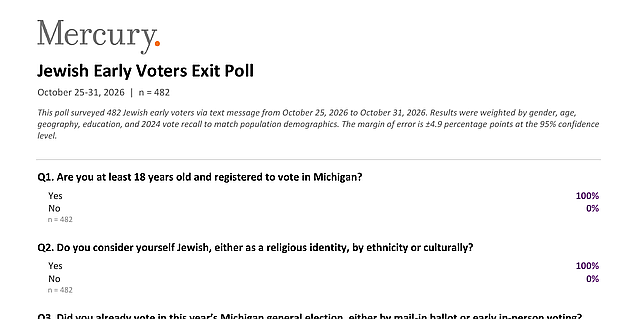
Methodology: The survey was conducted October 25–31, 2026, by Mercury Public Affairs on behalf of The Jewish Majority. The sample included 482 Michigan residents who identified as Jewish and had already voted in the 2026 general election, either by mail or through early in-person voting. Results were weighted by gender, age, geography, education and recalled 2024 vote. The reported margin of error is ±4.9 percentage points at the 95% confidence level for the full sample; subgroup estimates have greater uncertainty. Comparisons with 2024 are based on respondents’ recalled votes and do not directly measure individual-level voter switching.